
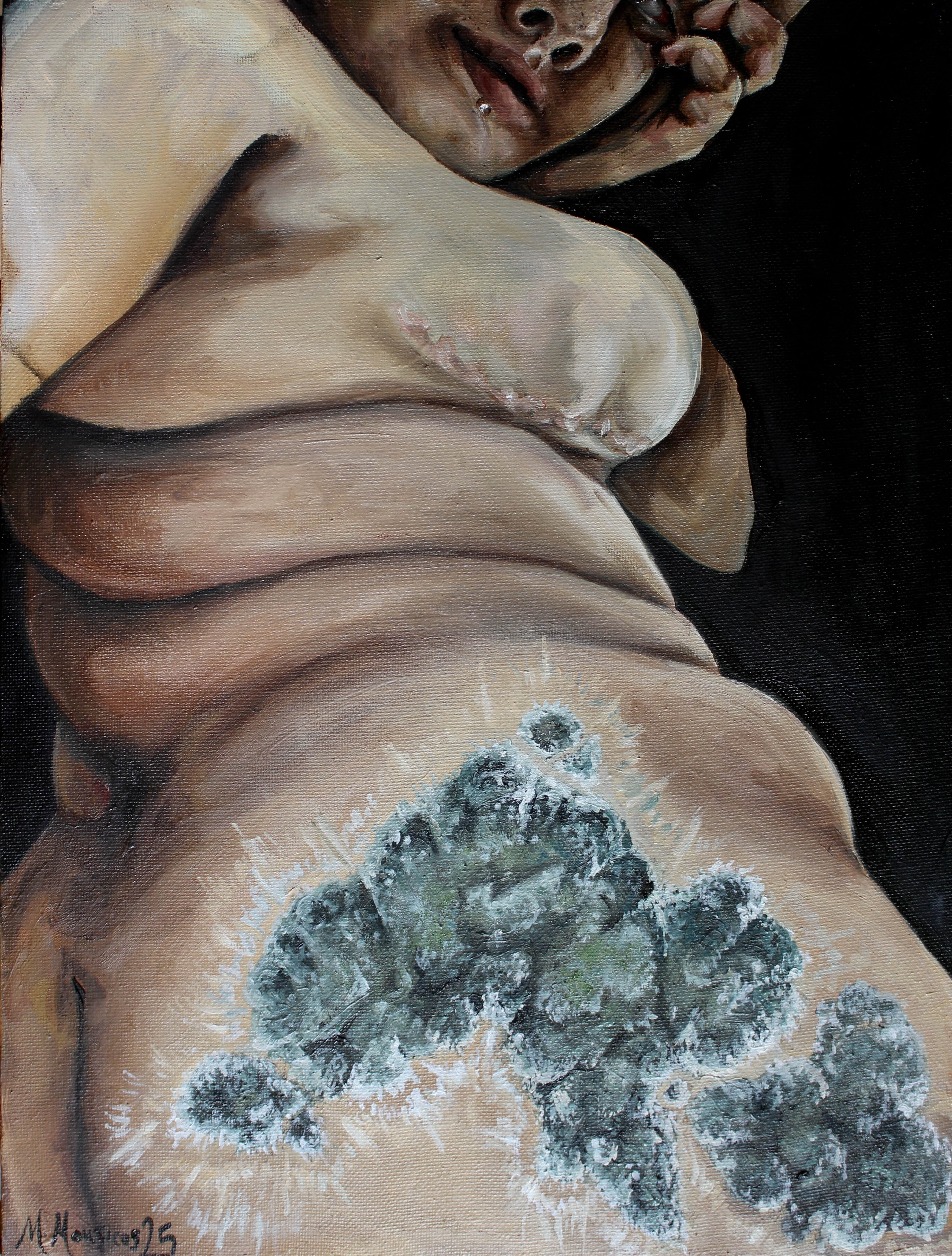

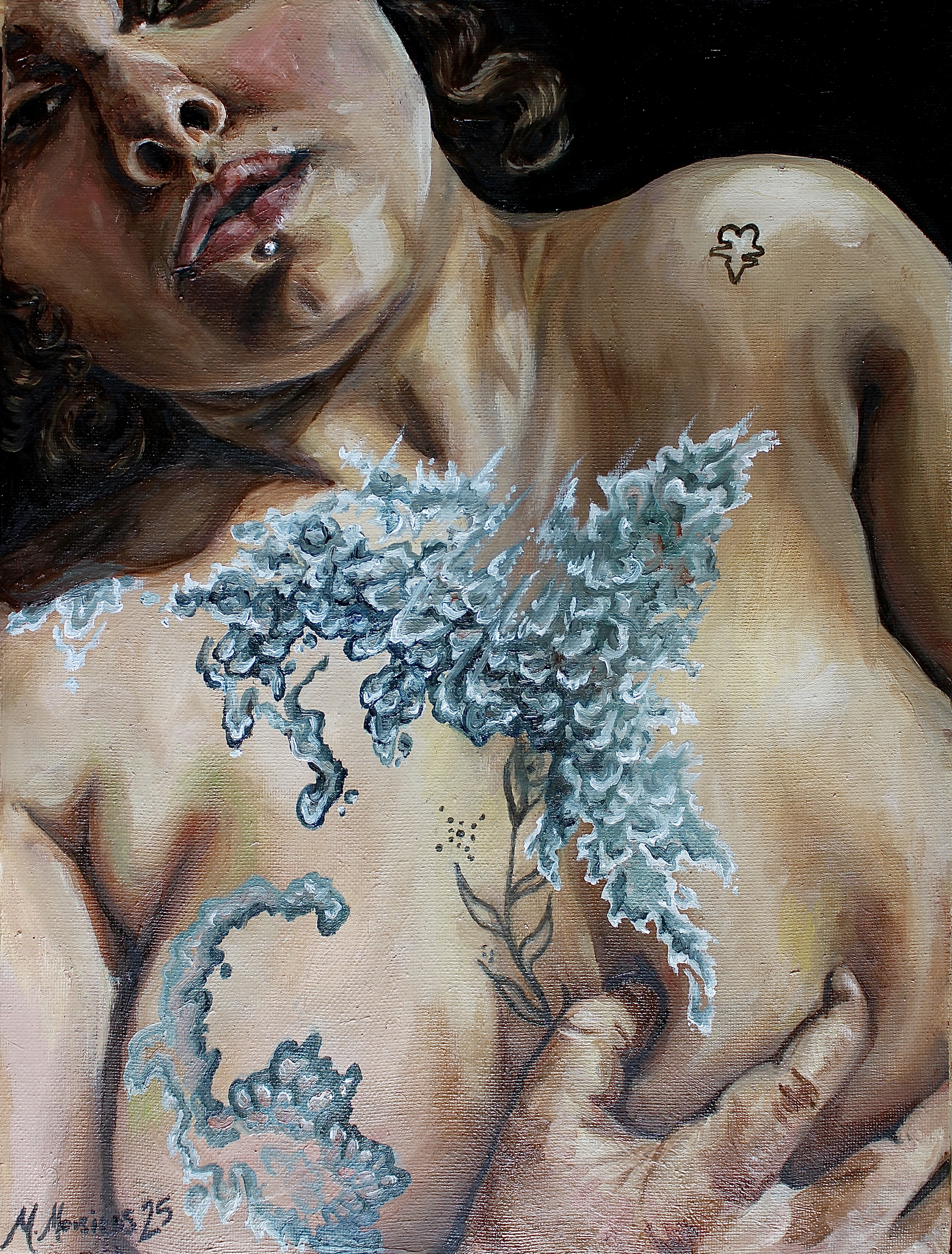
This series ‘I Feel Mould’ aims to connect the experience of chronic pain to the appearance of mould on self portraits of the artists. Mould being of a slow and subtle destructive nature, gross and not discussed. Much like the experience of chronic pain that many women have to suffer through while the medical industry does not accommodate for. Each portrait features depictions of mould on different sites to indicate where the artist feels pain as well as drawing on wider themes of a connection between income and pain, and the need to work worsening one’s symptoms.
The first in the series is named ‘In Your Head’, a double entendres to the phrase used to minimise female pain as well as a migraine, in which women are 3 to 4 times more likely to suffer from than men. Women are very commonly dismissed for their pain, culturally and societally, especially in the medical industry. This is further exacerbated for women of colour. The artist depicts how their migraines feel to them; like mould sprouting from the brain, wet rot building slowly over time, worsening and spreading.
The next piece is titled ‘£13.15 an hour’, that being the London Living wage at time of painting. The artist wanted to make clear that this was the price of their hip health, on their feet and deteriorating it for just £13.15 an hour. The mould appears sharp and violent, just as the artist’s hip pain feels. This work introduces the theme of a correlation between pain/chronic pain conditions and class. Those from a lower socio-economic background are much more likely to develop chronic pain conditions and live with more severe pain, for longer periods of their life. One of the contributing factors being that they cannot afford to stop working when they feel pain, despite it deteriorating their body and worsening conditions. In fact, it is normal and noble to do so. This obviously affects people of other intersections of oppression even greater.
The title ‘Hospitable’ once again has multiple meanings. The societal expectation for women to be hospitable, accommodating and meek – including in the workplace and often at the cost of their own physical and mental health. The artist, and the female body, as a host for the mould, infection and pain. It also playfully hints at the brutality on the body from the hospitality industry. The mould is subtle but penetrating, spilling must from the beds of the fingernails and the ear canals.
The 4th in the series is titled ‘Strong Independent Woman’. This verbiage can be seen as ‘empowering’ but is often rather restrictive and pandering. The attributes of absolute resilience, complete autonomy and confidence often means women have multiple burdens placed on them with no help. Then when a woman insists on her independence she is ridiculed, put down or dismissed – considered far from her femininity. Many women live with pain and chronic conditions, worsened by their responsibility that they must carry alone. Strong independent women are still gaslit by bosses and doctors, systemically unsupported and overlooked in their pain. This draws from the artist’s own experience, the irony of being labelled a ‘strong independent woman’ yet having their severe symptoms diminished. The mould is washing over the chest just the same as the pains of the artist’s body.
 Mikaella Mousicos